28 August 2026 · 7 min
Woollen and worsted
Two cloths can come off the same sheep, in the same colours, at the same sett, and have nothing in common to the hand or the eye. The difference is not the wool. It is what was done to the fibres before they were spun.
Combed, or not
Worsted yarn is combed. The short fibres are pulled out and thrown away, the long ones are laid parallel, and what is left is spun hard. The result is smooth, dense, and slightly lustrous, because parallel fibres reflect light in the same direction.
Woollen yarn is carded, not combed. Fibres of every length go in, lying every which way, and the yarn is spun softly to keep the air in. The result is fuzzy, light, warm, and matte — fibres pointing everywhere scatter light everywhere.
Everything else follows from that one decision. Worsted suiting holds a crease and shows a sharp twill line. Woollen tweed hides its structure under a haze of fibre ends and drapes soft instead of hanging straight.
What that looks like at thread scale
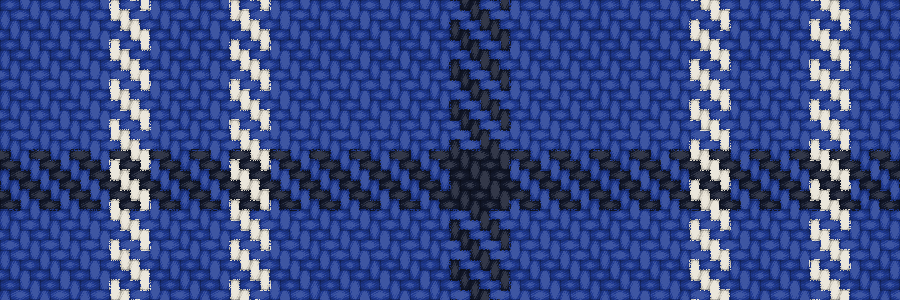
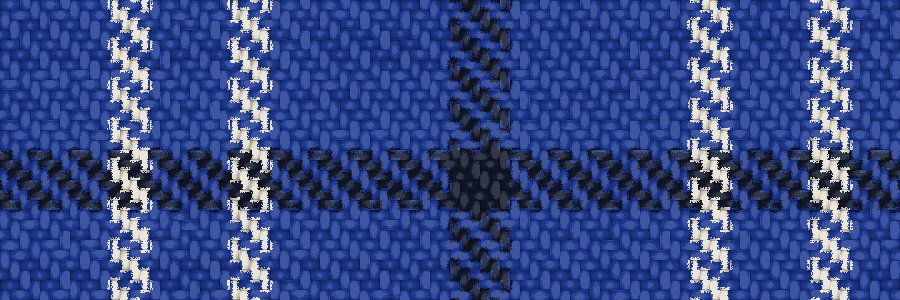
Both figures below are the same sett, the same colours and the same weave. Only the yarn differs. They are drawn at ten pixels a thread, because at swatch scale the difference is genuinely invisible — which is why so much cloth is bought by hand rather than by picture.
The five numbers
In the designer, a material is not a filter over the top of the render. It is five properties of the yarn, and each one changes the drawing for a different reason:
| Property | Woollen | Worsted | |
|---|---|---|---|
| Fibre length | 0.12 | 0.9 | 0 short, 1 long |
| Twist | 0.2 | 0.85 | 0 soft, 1 hard |
| Slub | 0.5 | 0.05 | thick-and-thin along the yarn |
| Crimp | 0.45 | 0.08 | how far an end wanders |
| Cover | 0.95 | 1 | how much space the yarn fills |
Fibre length is the one that carries the others. A short staple has more ends to shed, so it throws fibre further over its neighbours; a long one lies flat and throws almost none. The same number decides lustre, because a fibre lying flat along the yarn reflects and a fibre standing up does not.
Slub and crimp are the marks of a soft spin. A hard-twisted worsted end runs true and even; a softly spun woollen thickens and thins as it goes, and wanders off its line as the picks push it about. Ruler-straight ends are the loudest sign that a plaid was drawn rather than woven.
Tweed is woollen with the dial turned up
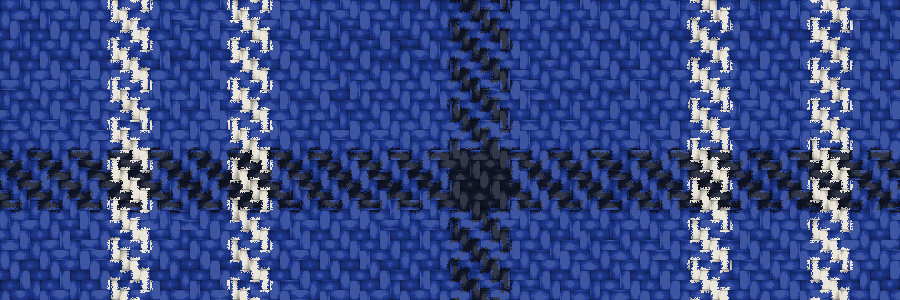
Tweed is not a third kind of yarn. It is a woollen, set more openly and spun deliberately unevenly — 0.85 slub against the woollen's 0.5, and 0.88 cover against 0.95. The unevenness is the point, not a defect to be corrected.
Which to specify
If the design depends on a crisp line — a fine check, a pinstripe, anything where two threads have to read as two threads — it wants worsted. If it depends on colour blending at a distance, which is most tweed and most heavy coating, it wants woollen: the haze of fibre is what mixes the colours in the eye.
A tartan drawn in worsted and woven in woollen will not look wrong so much as look softer than intended, with the fine lines closing up. That is worth knowing before the sample comes back.